
It’s swarm season folks and the air is a-buzz with thousands of bees looking for new homes. Swarming is a natural behavior for bees. In the spring time, they build up their population and outgrow the space that they’re in. They make a new queen (more on that in a different post), and take the old queen and approximately half of the worker bees in the hive and leave. For a beekeeper, when a hive swarms, it’s like losing half of your livestock. Someone once described it to me like this: it’s like raising cattle that decide to walk across the street and live and be productive for your neighbor. When a honeybee hive swarms, you lose half the population, and therefore a large productive workforce.
In an effort to prevent swarming, springtime becomes the beekeeper’s busiest season, and it has been no exception here at the Hercubees Home Apiary. If you recall, I had three hives coming out of winter (Hives 1, 2, and 3 in the below photo). These three hives started going nuts in early spring, and they were already thinking about swarming.

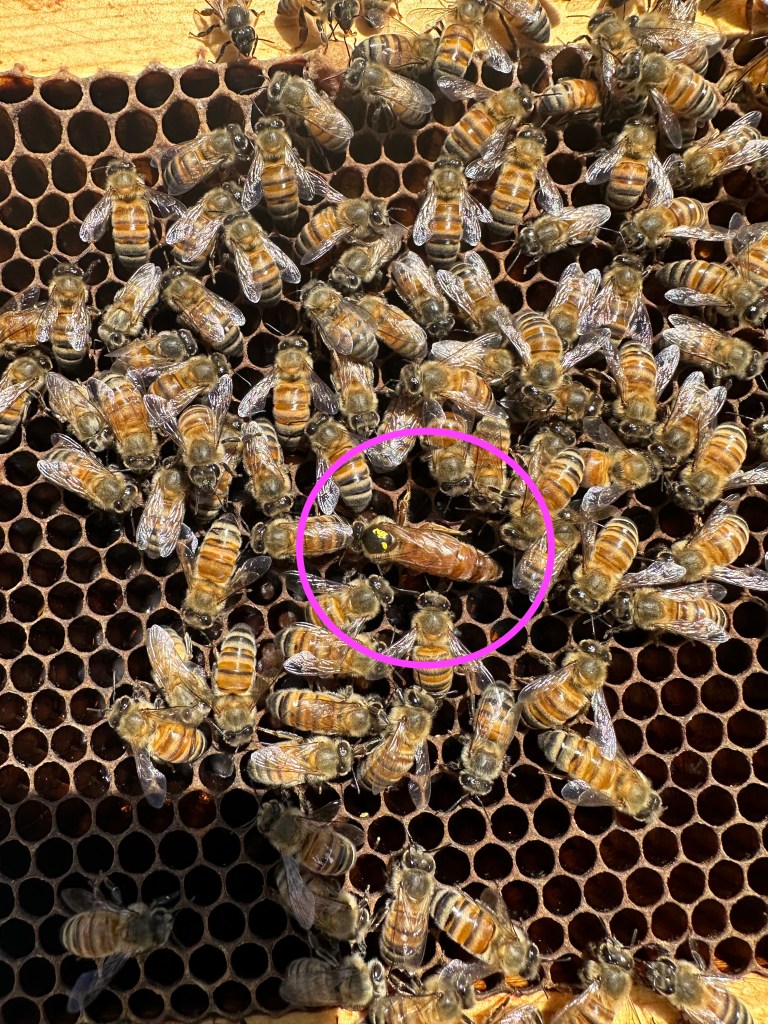
There are a number of different ways to prevent hives from swarming. One of the best and easiest ways is to find the old queen and remove her into a nuc box (a smaller colony, see #5) with some attendants and foragers, and let the bigger hive make a new queen. This is great if you can find the queen, which is sometimes easier said than done. I got so lucky with one hive. In hive 2, the queen came to say hello multiple times during the inspection, so I took her and put her into hive 5 (she is marked in yellow below, indicating she was born in 2022).
I couldn’t find the queen in hive 3, so I used a different technique called a walk-away split. I took a box of brood and a box of resources from the parent hive and moved them to a new location. This leaves a box of brood and a box of resources for the parent hive. The queen ends up in one of the hives, and the other hive will have to make their own queen. I got lucky and the queen ended up in the new hive (#6), leaving the parent hive (#3) queenless, which helps to prevent swarming.
That left my spicy girls in hive #1. This is my oldest colony and one of the originals that I started with (hives 2 and 3 were splits from this colony last year). These ladies have one mission – make honey and prevent anyone from stealing it…including me. During a strong flow, they can be quite calm, but pre-season they are unhappy if I disturb the hive. I opened these girls and they were making dozens of queen cells in preparation for a swarm. Because there were hundreds of bees dive bombing my veil, I didn’t bother searching for the queen (which would have been very difficult in a hive of this size), and did a 50-50 split. In the six box high hive, three boxes went to hive 4, three stayed with hive 6, and they each got another box for more space. I got lucky and the queen ended up in hive 4 out of pure luck.
All-in-all, I got lucky with my early spring splits so far. The queens ended up where they needed to be, and hopefully the other three queen-less hives are busy making their new queens, time will tell and there will be a full report on those hives in a few weeks.
There’s a whole different side to swarm season, and that’s catching swarms (wonder where the unnumbered colony in the apiary picture came from?). Stay tuned for the next post discussing what happens when you can’t control the swarming.
 Hercubees Honey
One response to “Swarmest Wishes”
Great article – and really fantastic pictures! ❤️
LikeLike